
Behind the Book: Q&A with Dr. Jefferson Holdridge
By Erin Marlow, Communications Specialist in the Office of the Dean of the College
Dr. Jefferson Holdridge, Professor of English and Director of Wake Forest University Press, recently published his volume of poetry The Bonds of Nest and Urn with Resource Publications. Drawing on inspiration from the natural world, personal experience, classical literature, visual art, and time spent in Ireland and Italy, the volume offers a nuanced exploration of how nature and culture shape human experience.
Dr. Holdridge spoke with the Dean’s Office about his work.
What inspired you to write this volume of poetry?
The Bonds of Nest and Urn was inspired by the second line of a quatrain by Walter Savage Landor, titled “Dying Speech of an Old Philosopher:”
I strove with none, for none was worth my strife:
Nature I loved, and, next to Nature, Art:
I warm’d both hands before the fire of Life;
It sinks; and I am ready to depart.
Though not quite ready to depart, I was struck by the word “next” to Nature. Does the poet mean equal to or secondary to? Probably secondary, but I wanted to explore the relationship between nature and art, as to which came first to mind. It’s complicated. To quote Sir Thomas Browne from the Religio Medici: “Now nature is not at variance with art, nor art with nature; they being both the servants of his providence: Art is the perfection of Nature: Were the world now as it was the sixth day, there were yet a chaos: Nature hath made one world, and art another. In brief, all things are artificial for nature is the art of God.”
In short, nature and art are twins. The question remained: how should I represent them? The figures in the title, Nest and Urn, felt appropriate, while The Bonds seemed to capture both their interconnection and my relationship to them, as well as my connections to other people, animals, etc. Nests are used to prove the existence of God by design, for how could a handless bird instinctively create such intricate things as some nests without a greater mind at work behind them? Shaped like a nest, urns are made to contain natural elements, such as oil, seeds, or our ashes. This led to an ongoing reckoning with the relationships among the two siblings, the figures of birth and death, and other intertwined figures of nature and art.
The Bonds of Nest and Urn also asks whether poetry can exist apart from history or even personal experience, though both history and the self are present in the poems that follow. For example, the formal study of “English Ivy” as an invasive, aggressive species became an exploration of colonization, while “Weeping Cherry” and “Weather” are considerations of the erotic and emotional basis of poetry; “Greenhouse” concludes with the hothouse ability of poetry to establish a place for the vulnerable to live and grow. The narrative movement of the poems is from art to nature, but there is a great deal of interlinking.
What was a major challenge that you faced in your writing and research process?
My major challenge was avoiding writing that was too rarefied so that people would care about what I had written. My purpose and my delight as a poet is to use traditional forms, meter, and rhyme for their primordial satisfactions. They are mnemonic; they appeal to a primitive love of sound and scansion. I agree with Robert Frost that writing in free verse is like playing tennis without a net (and that’s not fun, regardless of Sandburg’s reply). There can be a flatness to free verse, which Frost believed was concealed by “biblical intoning.” The Irish poet W.B. Yeats thought free verse was an “American vice.” As unlikely an aim as it may be, I hope to restore rhyme and meter to an American virtue at least as it was for Emily Dickinson. Though others share the aim, overall, such an attempt is swimming against the tide.
What would you say is your project’s unique contribution to the field? Larger society?
Poetry, like any art, contributes to larger society in ways too important and subtle to enumerate easily because poetic speech is, I think, our first response to the world and hopefully our last.
What’s next? Do you see your research evolving for future publications?
I am preparing two volumes that discuss the larger aims of my poetry as regards the contemporary moment; they are provisionally titled Disorder and Rule and Under the Receding Wave. Conversations with my family, my colleagues in the English Department and beyond, and across the disciplines are invariably part of my compositions, for which I am very grateful.
The Bonds of Nest and Urn
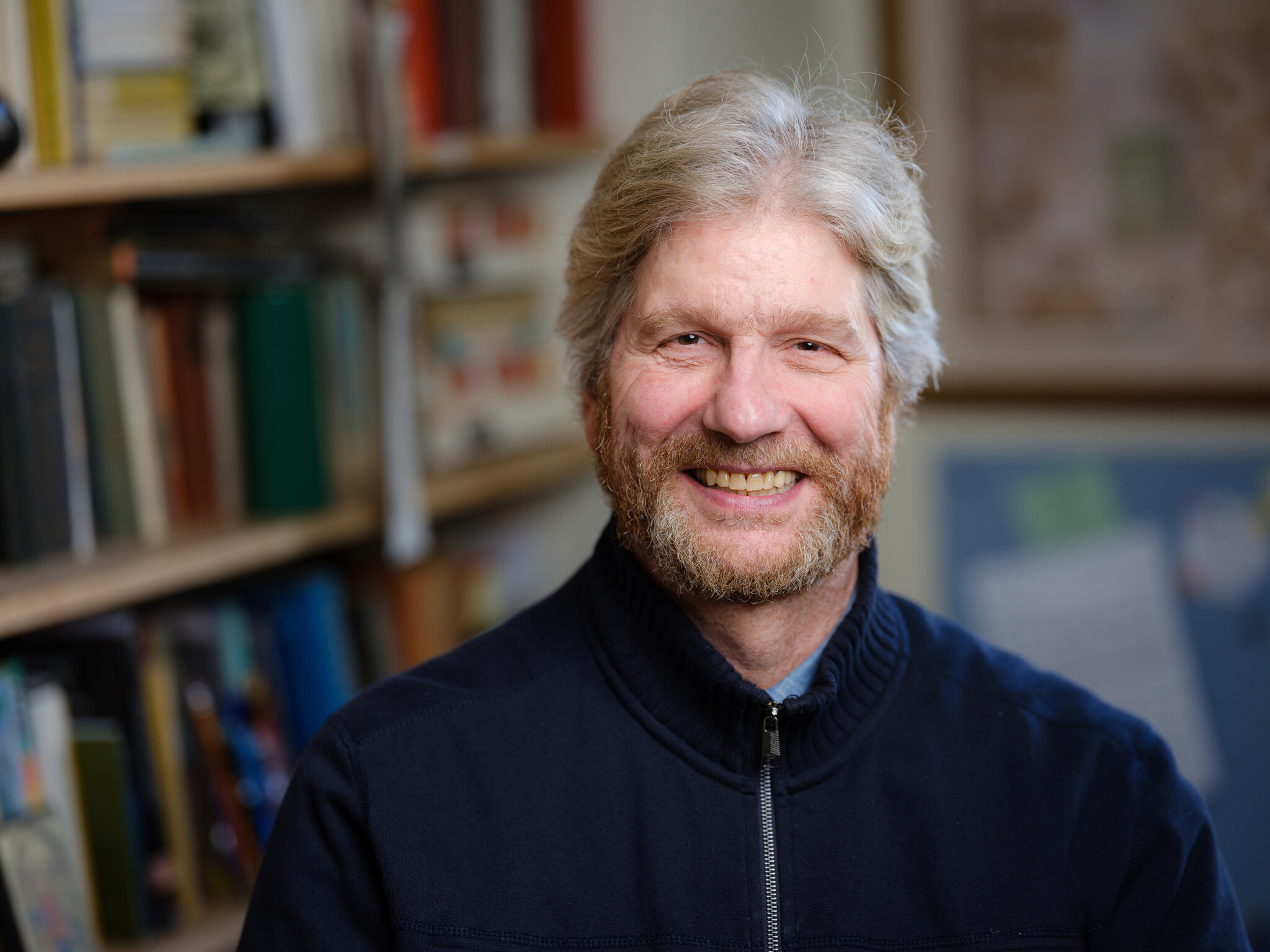
My purpose and my delight as a poet is to use traditional forms, meter, and rhyme for their primordial satisfactions. They are mnemonic; they appeal to a primitive love of sound and scansion.
Dr. Jefferson Holdridge